
Letter from a Reader 3.4.26
Kurt Vonnegut's wartime horrors, the curse of baby boomer bands, and the New York Times keeps talking out of both sides of its mouth on Belle Burden's 'Strangers'


A few months ago, I wondered in this space if people stopped reading John Irving after a certain age. My friends used to read Irving as avidly as millennials do Sally Rooney, I said, but that ended when children and mortgages arrived. The critic Joseph Epstein had proposed an explanation: “It is the young—or rather the youngish—to whom he appeals.”
Kurt Vonnegut is a much better writer than Irving, but lately I’ve wondered if something similar might be true of him. I discovered his novels as an undergraduate, and I can still see the vibrant covers of their Dell mass-market paperback editions lined up on a front table in a college shop called Town & Campus: red for Cat’s Cradle, blue for God Bless You, Mr. Rosewater, purple for Welcome to the Monkey House. At a price I could afford on my babysitting money, they became the first series of novels I’d bought since those of Agatha Christie.
I tore through perhaps a half dozen, grateful for their reliable distraction from finals and term papers. But I can’t recall a word of them today, except for three that appear so often in Slaughterhouse-Five, everybody else knows them, too: “So it goes.” I return regularly to Christie’s novels, but I’ve had no impulse to go back to Vonnegut’s, although their ironic sensibility is closer to mine than Christie’s more literal one.
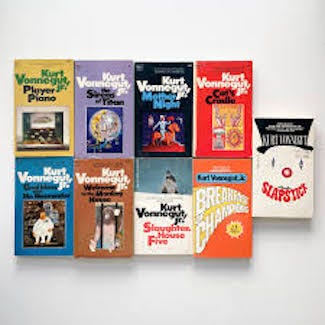
What I have gone back to is what Vonnegut saw in World War II. My edition of Slaughterhouse-Five had said only that he had survived the fire-bombing of Dresden, Germany, and the novel grew out of it. I had little idea of what that meant until details emerged in what I read later.
It meant essentially this: Vonnegut was a 22-year-old prisoner of war when his Nazi captors forced him, among other survivors of the bombing, to gather and burn vast numbers of corpses on huge funeral pyres in Dresden. He makes no mention of hoping to write about the horror in a letter to his family in Indianapolis, reprinted in Kurt Vonnegut: Novels & Stories 1963–1973 (Library of America, 2011). But the young Army private offers a glimpse of the spirit that would help to sustain his long career when he says the bombing had destroyed a beautiful city: “But not me.”

Quote of the day: the curse of the boomer bands
“The great curse of the baby boomer bands is to believe that rock’n’roll can still change the world.”
Graeme Thomson, the critic and biographer of Elvis Costello and Willie Nelson, in a review of the new U2 album Days of Ash in the Spectator

We don’t need more books with ‘resilience’ in the title
Hostage stories have a hard-to-resist allure if you believe, as I do, that we’re all captives of something. I could name a half dozen I’ve enjoyed more than most novels, including Ben Macintyre’s The Siege (Crown, 2024), the true story of how six men with submachine guns stormed the Iranian embassy in London in April 1980 and took 26 hostages they held for six days.
But I’m not panting for anthropologist Mimi Nichter’s new Hostage: A Memoir of Terrorism, Trauma, and Resilience (Potomac, 2026) after its favorable review in today’s Wall Street Journal. Nichter was a college senior on a TWA flight to New York from Israel in 1970 when passengers heard a chilling announcement in an unfamiliar accent: “This is your new captain speaking. You are being taken to a friendly country. Stay calm, we will not harm you.” She lived through a memoir-worthy drama after armed members of the Popular Front for the Liberation of Palestine hijacked her plane, crash-landed it in the desert in Jordan, and held her and others captive in Amman amid a civil war.
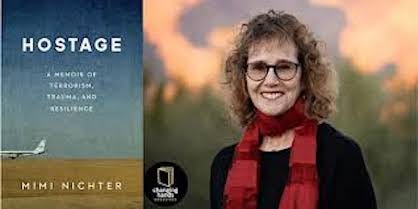
To my mind the problem didn’t involve her story but a word in her subtitle, “resilience,” which has become a terrible cliché in publishing.