
Letter from a Reader 6.22.26
The charm of novelist Donna Leon's memoirs, the 'groupthink' about Belle Burden, and: Are you 'treated like a 9-year-old' by Ann Patchett's 'Whistler'?

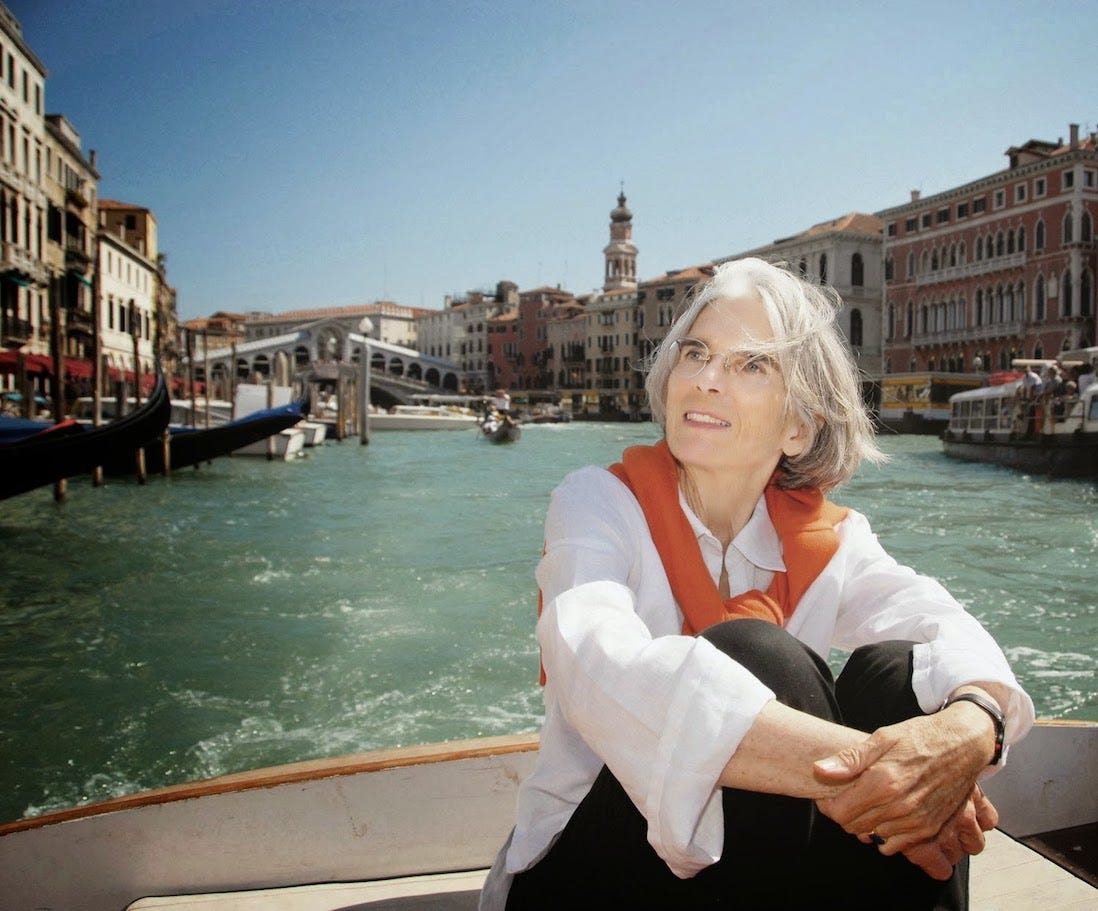
Donna Leon’s memoirs have a modesty as charming as it is startling in an author of her stature. It might be an exaggeration to say that Leon’s fans think she hung the moon over Venice, where her Commissario Guido Brunetti of the Italian State Police has solved crimes in 33 novels.
But consider the facts. Julian Fellowes, the creator of “Downton Abbey,” plans to adapt Leon’s rightly admired books for TV. Her novels have inspired walking tours of Venice and a cookbook that tells how to make Brunetti’s favorite pasta and his wife Paola’s apple cake. And yet Leon believes she shouldn’t be advising authors on how to succeed. Or so she says in Backstage: Stories of a Writing Life (Grove Atlantic, 2025), the second volume of her memoirs.
“It is hardly my place to tell writers what do,” Leon writes, while allowing that “it is common sense to observe that most people have a natural curiosity about why things happen.” It’s her way of saying that you can have a great plot, setting, and cast of characters and still lack a vital element in fiction: “a reason why everything happens, a motive.” Without it, your readers may have no feeling for your characters, lacking an understanding of why they act as they do.
More than a reluctance to prescribe makes Backstage unusual. Born in 1942 in Montclair, N.J., to hardworking parents of Latin American ancestry on one side and Irish and German on the other, Leon spent much of her adulthood in Venice and now lives in Switzerland. She builds on her 2023 memoir, Wandering Through Life, in Backstage, which collects 32 brief essays with more highlights of her global adventures.

Her most dramatic story involves her early work of teaching English for the Bell Helicopter company in Iran as the Shah fell. As tanks rumbled in the streets, she and other Americans fled to the Inter-Continental Hotel in Tehran, which had walls full of bullet holes and beds strewn with glass from shattered windows. She doesn’t connect her escape from the country to her later career, but you can see why the uncertainties of a writer’s life might have seemed easier to bear after that terror.
Leon reveals her literary methods less through her occasional glimpses of how she writes than in her astute analyses of authors who get their own chapters. Leon shows perceptively how Raymond Chandler rewrote the unwritten rules of Agatha Christie–like detective fiction in his most famous novel, The Big Sleep, and others. She defends passionately the seafaring exploits of her adored Jack Aubrey and Stephen Maturin in Patrick O’Brian’s “Master and Commander” books. And she sums up the title character of Tolstoy’s The Death of Ivan Ilyich, who injures himself while hanging curtains, in five apt words: “He dies for his drapes.”
In her most unusual chapter, Leon writes a short love letter to her sleuth that explains why she’s stayed with him for 30 years as he and Venice have changed. Beginning with “Dear Guido” and ending with “Love, Donna,” it may strike some as a bit twee.