
Letter from a Reader 8.6.26
Friday Flashbacks on Henry James' 'The Portrait of a Lady,' 'Ebert's Little Movie Glossary,' and an entertaining book of poems for children

Are you tired of feeling sucker-punched by new books that critics or awards-judges love but you found not worth your time? Me, too. It happened again when I read Kathryn Stockett’s overrated cinder block The Calamity Club, which has spent 13 weeks on the New York Times hardcover fiction bestseller list.
I finished Stockett’s novel thinking you and I might have been better off if I’d revisited one of the worthier books I’d reviewed, or at least read, in the past. And that’s what I’ll be doing in the weekly Friday Flashbacks series I’m launching today.
Every Friday I’ll revisit one or more books I’ve enjoyed, whether last year or decades ago. I’m not rereading all of them, which would leave no time for the new books I want to keep reviewing. I’m instead reposting all or part of reviews that seem to have held up well. In some cases, without altering my view of a book, I’ve rewritten or heavily edited or condensed the content to avoid violating a copyright owned by a former employer. In others, where I hold the copyright, I’m reposting a review.
Most books I’ll revisit remain in print and widely available. But I’ll do out-of-print books if you might find a review helpful or entertaining or the book worth seeking out. This post is free, but future Friday Flashbacks will be a bonus for paid subscribers.
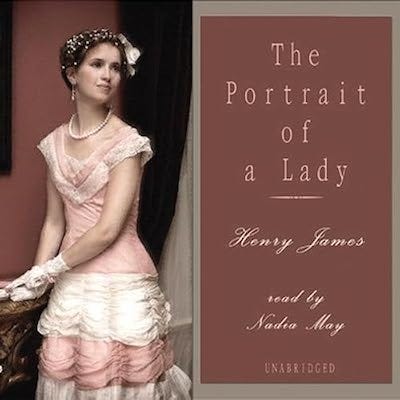
‘The Portrait of a Lady’ by Henry James (many editions, 1881)
Henry James wrote “no more entertaining, no more glamorous novel” than The Portrait of a Lady, the literary critic Richard Poirer rightly wrote in a Library of America edition. That makes it an ideal point of entry to his fiction. James’ later novels can seem forbiddingly abstruse or mannered. But the writing in The Portrait of a Lady is never less clear than in its first line:
“Under certain circumstances there are few hours in life more agreeable than the hour dedicated to the ceremony known as afternoon tea.”
In his early chapters, James might seem to be setting up an unusually elegant romance novel. He introduces his beautiful, young, American heroine, Isabel Archer, by saying that she tended to suffer from “the sin of self-esteem” and had “the habit of taking for granted, on scanty evidence, that she was right; impulsively, she often admired herself.”
Those words foreshadow what will befall Isabel, whose desire for self-determination will be her undoing in a novel that ultimately subverts romance-novel conventions instead of following them. Orphaned in her early 20s, Isabel finds a patron in a rich aunt, who takes her from Albany, New York, to Europe. There three men court Isabel: Lord Warburton, a kind and attentive English aristocrat; Caspar Goodwood, a Massachusetts mill owner who pursues her across the Atlantic; and Gilbert Osmond, an American expatriate in Rome.
Isabel has been left a fortune by an uncle, who conveniently dies soon after she arrives in England. This allows her to imagine a future different from that of other women her age, or to reject the idea that she must wed before her beauty fades.
“I don’t see what harm there is in my not wishing to tie myself,” she tells a friend. “I don’t want to begin life by marrying. There are other things a woman can do.”
Is Isabel right? Does she have what modern single women might call “options”? James said he had envisioned The Portrait of a Lady as the story of a young woman “affronting her destiny.” But the novel, his greatest, ultimately deals with a larger question than whom Isabel will marry, or even the limits on women in Western culture. As James’ biographer Leon Edel wrote:
“In seeking to show a young girl affronting her destiny Henry James found himself asking a large universal question: What do people make of their lives and why?”


‘Ebert’s Little Movie Glossary: A Compendium of Movie Cliches, Stereotypes, Obligatory Scenes, Hackneyed Formulas, Shopworn Conventions, and Outdated Archetypes’ by Roger Ebert (Andrews McMeel, 1994)
Roger Ebert started to notice things after he’d been going to movies for a while. He noticed how movie computers made little clicking sounds when somebody typed, although terminals hadn’t made that much noise since the days of the teletype. He also noticed how, whenever a hero knocked out a Nazi guard and put on his uniform, the uniform always fit perfectly.
Ebert described some of his amusing observations in his reviews for the Chicago Sun-Times, and with help from his readers, gathered enough to fill the 116 pages of Ebert’s Little Movie Glossary. A reader from Wyoming spotted the “Brick Wall Paradox” of movies like “Home Alone”: “If a character, while swinging from a rope in an affluent suburb, slams face-first into a brick wall, that character never experiences any injuries other than moaning and groaning and sliding off the wall.” No doubt some directors have repented of their clichés since the publication of this book by the first film critic to win the Pulitzer Prize for criticism. But movie-lovers may enjoy its witty appraisals of films they grew up with or still watch on Netflix.
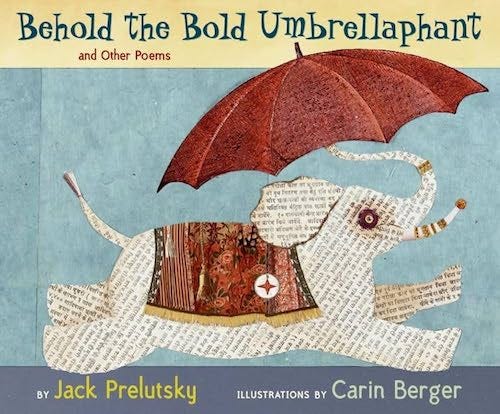
‘Behold the Bold Umbrellaplant’ by Jack Prelutsky, illustrated by Carin Berger (HarperCollins, 2008)
“Behold the bold UMBRELLAPHANT
That’s not the least afraid
To forage in the broiling sun
For it is in the shade.”
Poet Jack Prelutsky and artist Carin Berger team up in a delightful picture book inspired by Lewis Carroll. Or, more specifically, by the timeless whimsy of his poem “The Crocodile,” which begins: “How doth the little crocodile / Improve his shining tale, / And pour the waters of the Nile / On every golden scale!”
“The Crocodile” parodied an Isaac Watts poem, and you might call “Behold the Bold Umbrellaphant” a parody of a parody. But Prelusky’s book is less a parody than an homage.
Like “The Crocodile,” most poems in Behold the Bold Umbrellaphant use the ballad stanzas known as common meter or “hymn” stanzas, or alternating lines of iambic tetrameter and iambic trimeter with rhyming first and third lines. And Prelutsky stays close enough to Carroll’s work that his book could have sounded like a tired imitation.
But his poems have a charm of their own, paired with vibrant mixed-media illustrations by the much-honored Berger. Each poem describes a creature that is part animal and part familiar object: an elephant with an umbrella for a trunk in the “The Umbrellaphant,” an octopus with an alarm clock for a head in “The Clocktopus.”
This device could have been too clever by a half. It isn’t. Prelutsky keeps most poems as simple and descriptive as “The Panthermometer,” about a panther with a thermometer for a tail: “Here comes a PANTHERMOMETER / A cat we fondly hail, / For we can tell the temperature / By looking at its tail.”
Will young readers get the puns and other wordplay in poems like “The Lynx of Chain”? They don’t need to get them. Like Carroll’s “Jabberwocky,” the poems in Behold the Bold Umbrellaphant are nonsense verse, a form that uses whimsical or incomprehensible words to comic effect. And not the least of the merits of this book is that it may help to prepare children to appreciate Carroll and other masters of that underappreciated art.
Some of my comments on The Portrait of a Lady and on Ebert’s Little Movie Guide first appeared, in different form, in the Plain Dealer, then Ohio’s largest newspaper, where I edited the book section for more than a decade. My review of Behold the Bold Umbrellaphant first appeared on a book-review blog I ran in the early 2000s. As with all of the Jansplaining newsletters, you’ll find selected links to further resources at the end of post.
Jan Harayda is an award-winning critic and journalist who has been the book columnist for Glamour magazine and a vice president of the National Book Critics Circle.
Selected Notes
https://www.amazon.com/Eberts-Little-Movie-Glossary-Stereotypes/dp/0836280717
https://www.loa.org/books/57-novels-1881-1886/
https://www.newyorker.com/magazine/2012/09/03/out-of-the-frame
http://www.carinberger.com/Carin_Berger_About.html
Would you rather read about book-reviewers’ clichés than the overfamiliar movie tropes Roger Ebert tweaks? I wrote about 67 on them in one of my most popular posts:
67 cringe-worthy clichés of book reviewing

You might think that if anyone would recognize a publishing cliché, it’s Gilbert Cruz, the editor of the New York Times Book Review. Or you might think that if he didn’t, an alert copy editor would jump in to say, “Hey, don’t we have some pride left her…
I was forced to read Henry James in high school and again in college. I think Mark Twain put it best: "The problem with Henry is he has a tendency to chew more than he bit off."
I love this idea!